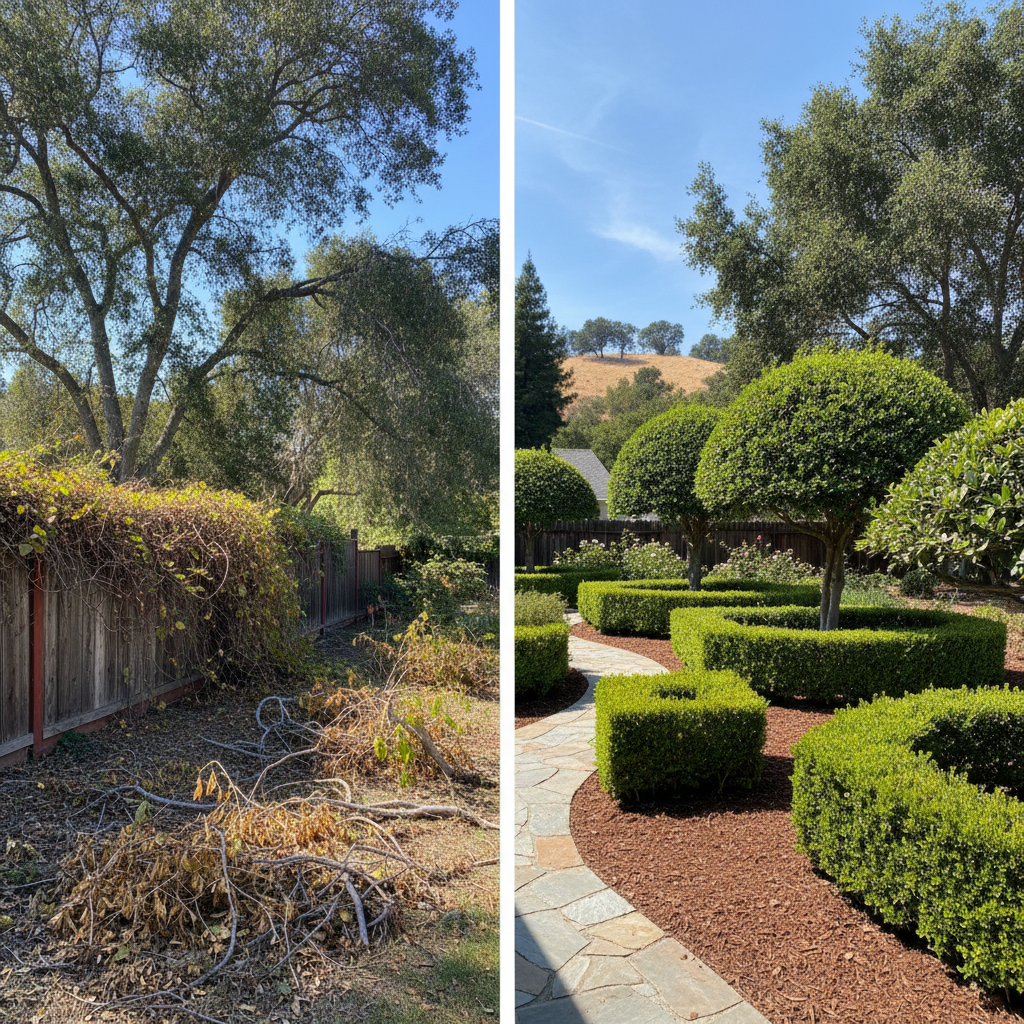
You've got shrubs and bushes, right? Every homeowner in Menlo Park does. Maybe it's a row of pittosporum along your fence, some azaleas by the front door, or those classic boxwoods framing your walkway. At some point, you're going to need to trim them. And that's where the big question comes in: do you shear 'em or do you selectively prune 'em?
It's not just a matter of preference; it's about what's best for your plants, your property, and your budget in the long run. I've seen both approaches done well, and I've seen them done really, really poorly. Let's talk about the pros and cons of each.
Shearing: The Quick & Uniform Look
Shearing is what most people picture when they think about trimming hedges. You take a power hedge trimmer, usually a gas-powered one for speed, and you buzz the plant into a uniform shape – a perfect square, a neat rectangle, or a smooth dome. It's fast, it's efficient, and it gives you that crisp, manicured look.
The Good Stuff About Shearing:
- Speed: This is the big one. Shearing is much quicker than selective pruning. If you're paying someone by the hour, or if you're doing it yourself and want to get it over with, shearing wins hands down.
- Uniformity: You get a very neat, formal appearance. For hedges that define a border or create a clean line, shearing is often the go-to.
- Cost: Because it's faster, it's generally cheaper if you're hiring a service. Less time on site means a smaller bill.
The Downside of Shearing:
- Plant Health: This is where shearing can really fall short. When you shear, you're often cutting off the tips of all the branches, which stimulates new growth right at the surface. Over time, this creates a dense outer shell of foliage, but the inside of the plant gets less light and air. It can become woody and sparse on the interior. This 'shell' also makes it harder for the plant to recover from disease or pests because air circulation is poor.
- Appearance Over Time: While initially neat, that dense outer layer can look unnatural. Plus, if not done regularly, it can lead to plants becoming top-heavy and leggy at the bottom.
- Flower Loss: If your shrubs flower on old wood (like many hydrangeas or azaleas), shearing at the wrong time will cut off all your flower buds for the season. You'll get green, but no blooms.
- Durability: Plants that are constantly sheared can become weaker over time, more susceptible to stress, and may not live as long or thrive as well as those pruned differently.
Selective Pruning: The Art of the Cut
Selective pruning, sometimes called hand pruning or structural pruning, is a more thoughtful approach. Instead of just buzzing the surface, you're looking at each branch and making individual cuts. You're removing dead, diseased, or crossing branches, and guiding the plant's growth to maintain its natural shape and promote overall health.
The Good Stuff About Selective Pruning:
- Plant Health: This is the biggest advantage. Selective pruning opens up the plant, allowing better air circulation and light penetration to the interior. This promotes stronger, healthier growth from the inside out, reduces the risk of fungal diseases, and helps the plant maintain its vigor.
- Natural Beauty: Your shrubs will look more natural and organic. You're enhancing their inherent form, not forcing them into an artificial shape. This often means more flowers and healthier foliage.
- Longevity: Healthy plants live longer. By promoting good structure and removing problem branches, you're extending the life of your landscape investments.
- Better Recovery: If a branch gets damaged, you can make a clean cut back to a healthy lateral branch, which is much better for the plant than just shearing off the damaged tip.
The Downside of Selective Pruning:
- Time & Cost: It takes longer, plain and simple. Each cut is deliberate. This means if you're hiring a professional, it's going to cost more than a quick shear.
- Skill: It requires more knowledge and skill. You need to understand plant growth habits, where to make cuts, and what branches to remove. It's not something you can just pick up a tool and do perfectly on your first try.
- Less Formal: If you absolutely need that perfectly geometric hedge, selective pruning might not give you the ultra-crisp lines you're after.
So, What's My Recommendation for Menlo Park?
Look, if you've got a formal hedge that you need to keep razor-sharp for a specific aesthetic, and you're prepared for more frequent maintenance to keep it healthy, shearing might be your thing. We see that sometimes in those older, more formal estates around the Allied Arts Guild area.
But for the vast majority of homeowners in Menlo Park, especially with our long growing seasons and occasional dry spells, I'm going to lean heavily towards **selective pruning**. Here's why:
- Plant Health & Durability: Our climate here in California can be tough. Healthy, well-structured plants are more resilient to drought, pests, and disease. Selective pruning builds that resilience.
- Beauty: Most plants look better when they're allowed to express their natural form. You'll get more flowers, better foliage, and a more vibrant landscape.
- Long-Term Value: While the upfront cost might be a bit higher for selective pruning, you're investing in the long-term health and beauty of your plants. You'll likely have fewer problems down the road, and your plants will thrive for years.
Think of it this way: shearing is like getting a buzz cut every month. It's fast, but it doesn't do much for your hair's health or style. Selective pruning is like getting a thoughtful haircut that considers your hair type and desired look, promoting overall health and growth.
At All Things Tree, we always prioritize the health of your plants. We believe in doing the job right, which usually means a more thoughtful, selective approach. If you're unsure what your specific shrubs need, give us a call. We can take a look and give you an honest assessment. It's your yard, and you want it looking its best, right?